


An Unprecedented President: Trump's Impeachment
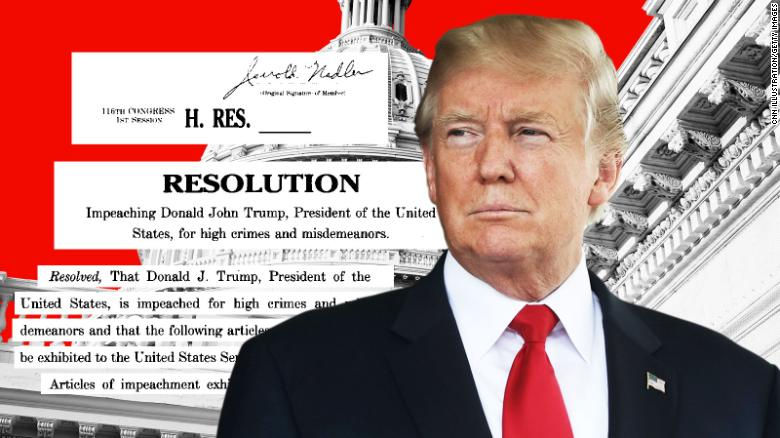
The Articles of Impeachment Against President Trump. Image Source: CNN
The Constitution
In 1787, the United States of America formally sought to establish itself as a federal republic within the proposed Constitution. The "Father of the Constitution," James Madison, believed that operating the government as a republic would ensure its longevity and opposed a pure democracy for fear of oppressing minorities (the opulent) and repressing the people. A republic, or a representative democracy, intends to pronounce the public voice through a chosen body of representatives. In Federalist 10, Madison explains his decision as a way to prevent faction, stating the following: "Complaints are everywhere heard from our most considerate and virtuous citizens, equally the friends of the public and private faith, and of public and personal liberty; that our governments are too unstable; that public good is disregarded in the conflicts of rival parties; and that measures are too often decided, not according to the rules of justice, and the rights of the minor party; but by the superior force of an interested and overbearing majority." Today, the country can be considered a constitutional representative democracy, as was intended when the Constitution was drafted more than 200 years ago. With this in mind, democracy is not to be considered antithetical to a constitutional republic, but necessary to upholding and furthering a republic. The founders viewed representative democracy as a solution to their perceived evils of direct democracy and a way to improve a republic system, often using the terms synonymously.
As both a federal republic and constitutional representative democracy, the United States maintains a presidential head of state and body of elected officials that seeks to represent the people. The House of Representatives and, after the ratification of the Seventeenth Amendment, the Senate, creates legislation in supposed accordance with their congressional districts. These chambers serve as the Legislative Branch of the government. Additionally, there is an Executive Branch, which the President is part of, and a Judicial Branch, where judges appointed by the President maintain a system of federal courts. This separation of powers makes it less likely that individual members of the government will act capriciously, forgetting to represent the people. Each branch takes on different responsibilities to prevent any form of absolute power, which allows for a system of checks and balances. For example, the President may veto laws passed by Congress, and the Judicial Branch uses the Constitution to oversee and check the other branches. One of the most turbulent forms of checks and balances is the Congressional power to impeach and remove a president from office.
The Constitution grants the House of Representatives the power and responsibility of impeachment. After approval by the Speaker of the House, the Judiciary Committee may proceed with composing the Articles of Impeachment. The full House can then vote for or against the charges, and the outcome determines if the Senate will hold an impeachment trial. For the President to be convicted and removed from office, a two-thirds majority vote is required of the Senate. Article 2, section 4 of the Constitution addresses the removal from office of executive branch positions when convicted in an impeachment trial of “Treason, Bribery, or other high Crimes and Misdemeanors.” Specifically, the President, Vice President, and all civil officers are held to this clause.
Structurally, the Constitution seeks to protect the American people against corruption across all branches, and the impeachment process directly protects them against executive corruption and abuse of power. The ‘principles of anti-corruption’ are a freestanding, implicit principle embedded in the Constitution that functions alongside impeachment and the Emolument Clause as part of checks and balances. The impeachment process is not taken lightly by Congress. In history, only three United States presidents have been impeached by the House, and no president has been removed from office by the Senate.
Donald Trump’s Impeachments
Trump’s first impeachment began in December 2019 after the House charged him with abuse of power and obstruction of Congress, under Articles 1 and 2 of the Constitution, respectively. The charges resulted from allegations that the president had solicited Ukrainian president Zelensky to interfere with the 2020 United States presidential election. A whistleblower revealed that Trump asked Zelensky to investigate Joe and Hunter Biden. The Senate acquitted Trump, and he stayed in office.
In January 2021, Donald Trump was impeached for a second time on account of inciting an insurrection against the United States government. A mob of Trump supporters violently overtook the United States Capitol with the encouragement of the President on account of the recent election being “stolen.” In a speech given the day of the riot, he was quoted saying to “walk down to the Capitol,” that “You will never take back our country with weakness,” and “take the country back” to his followers. Trump later tweeted that “Mike Pence didn’t have the courage to do what should have been done to protect our country and our Constitution, giving States a chance to certify a corrected set of facts, not the fraudulent or inaccurate ones which they were asked to previously certify. The USA demands the truth!”. The Capitol breach ended in the injury and death of many. The events took place only weeks before the transfer of powers from Trump to Biden. If Trump is found guilty by the Senate, he could be disqualified from holding any future position in government. Around half of American citizens believe that the Senate should convict him and those opposed argue that it is unconstitutional to try an ex-president before the Senate. Moving forward with the trial will result in some level of criticism of the Senate, being that Trump is now a private citizen.
Members of Congress had previously failed to impeach Donald Trump in 2017, on assertions that he violated the Foreign Emoluments Clause during his initial campaign for the presidency. Allegations included accepting money from foreign dignitaries and campaign collusion with Russia or Ukraine. The House, then controlled by Republicans, rejected the impeachment resolution in a landslide. In Article 1, Section 9 of the Constitution, the Emoluments Clause states that: “No Title of Nobility shall be granted by the United States: And no Person holding any Office of Profit or Trust under them, shall, without the Consent of the Congress, accept of any present, Emolument, Office, or Title, of any kind whatever, from any King, Prince, or foreign state.” This serves as an anti-corruption provision against executive powers that may be influenced to act unethically, rather than for the good of the people. Many emolument cases have been made against Trump, but none have succeeded.
America’s Future
Trump’s presidency has changed the United States, for better or for worse. Certainly, most can agree that this time has seen unprecedented division between Democrats and Republicans. Even after President Biden has taken office, we are awaiting the results of Trump’s impeachment trial. America’s generation of youth has already lived through many historical moments, which we as Americans must learn from and use as a way to better unite our country moving forward. In order to preserve democracy, presidents must be critiqued and held accountable for any breaches of trust with their people.
What Can You Do?
It is important that you take the time to do your own research on the politics of America- past and present. In the citations below are many sources to get you started, but watching the news and reading the daily headlines can be a great implementation into your daily routine. Additionally, Trump’s second impeachment trial by the Senate will begin in the week of February the 8th, so related news articles will be instrumental to understanding the current state of the government.
Edited by: Amy Quinn
Sources
www.justfactsdaily.com/the-u-s-is-a-democratic-constitutional-republic-and-yes-it-matters
www.nrdc.org/experts/mitchell-bernard/house-defended-our-democracy-now-senate-must-do-same
www.vox.com/21506029/trump-violence-tweets-racist-hate-speech
www.history.com/topics/united-states-constitution/constitution
www.history.com/topics/us-government/impeachment-in-us-history
www.law.cornell.edu/constitution-conan/article-2/section-4/impeachment
slate.com/news-and-politics/2020/10/republic-democracy-mike-lee-astra-taylor.html
spectator.org/trump-impeachment-unconstitutional-undemocratic/
www.dailykos.com/stories/2013/1/10/1177791/-Madison-Republic-Democracy-Factions
www.history.com/news/foreign-influence-constitution-founding-fathers


Comments