


Britain’s Hundred-Year Housing Crisis
From Lloyd George’s ‘homes for heroes’ to Thatcher’s ambition of a property-owning democracy, housing has been at the centre of British politics for over a century, with successive governments leaving the next to deal with it.
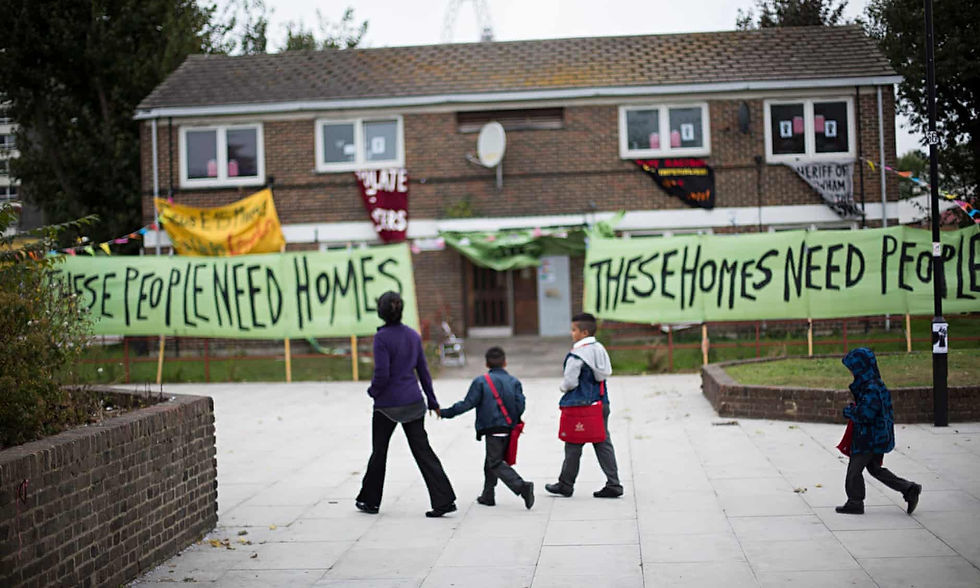
Unlike key areas such as health and education, housing policy is plagued by swings in the levels of investment and subsidy. Expenditure on housing programmes is invariably linked to economic performance, meaning that doors of opportunity open only to be slammed shut soon after. Most do not understand housing as a policy area that requires a long-term commitment to investment and support; thus, the UK housing market suffers from never-ending crises. For the cycle to break, housing must be treated as a human necessity on an equal footing to health.
The link between housing and health:
William Beveridge was a social economist who, in November 1942, published a report titled, 'Social Insurance and Allied Services' that would provide the blueprint for social policy in post-war Britain. His 'cradle to the grave' social programme that, amongst other proposals, called for a free national health service and the abolition of slums, battled against what he called the five giants; idleness, ignorance, disease, squalor, and want.
The ‘slum problem’ was a prominent topic in political discourse. Beveridge devoted nine pages to analysing the ‘rent problem.’ The drawn conclusion was that flat-rate benefits paid at subsistence level for flat rate contributions should be implemented. Paying the national average rent is differentiated according to worker and pensioner households. Thus, due to regional rent variations, the report would not have delivered subsistence for all. Further restricting this plan was its implementation by the Labour government of 1945-51. The 1945 Family Allowance Act set allowances at 25p for the second and subsequent child rather than Beveridge’s 40p recommendation.
The report also found that health and poverty are habitually linked to housing standards, and so the housing crisis in the UK continues to drive up levels of both poor health and poverty. In 1997, child poverty lay at 29% before housing costs and 36% after housing costs. In 2019 this rose to 20% before housing costs and 30% after with 1.4 million displaced. Although progress has been made in improving basic housing standards over the last 80 years, squalor remains in the UK.
The privatisation of social housing:
The Housing Act of 1980 gave council house tenants the ‘right to buy’ their homes from the council below market price – this was the beginning of the privatisation alongside today's housing crisis. The purpose of the policy was to convert Britain into a property-owning democracy by supporting the aspirational working classes who otherwise could not afford to purchase a house. This policy was also used as a tool to implement ‘popular capitalism’ by the means of ordinary citizens becoming mortgage holders or members of a building society. By 1990, 68% had a stake in the capitalist system via a mortgage with 1.8 million council houses purchased; upon Thatcher’s arrival to office, 53% of Britain owned their own home.
Although the ‘right to buy’ can be perceived to have benefitted Britain in several disparate ways, the sale of council housing for short-term financial gain is the root of Britain’s housing crisis. The policy undermined the principle of social housing, which is that the state has a role in providing a minimum quality of housing for the people whom it represents. From this point onwards, the housing market has become dominated by private builders who are motivated by a profit incentive rather than maximising the welfare of society. The significance of this lies in an increase in these homes becoming owned by private landlords. Thus, there is less social housing available for those who need it. From the 1980s onwards, the lack of social housing has meant the inability of supply to meet demand. Hence, this is the root of the housing crisis today, with 8.4 million people currently affected by a policy implemented by the Thatcher government.
The policy also initiated a turning point for many towns in the UK, which had a high proportion of social housing. Social housing became a byword for poverty and deprivation, creating inner-city ghettos and the beginning of many social problems that blight council estates in the UK. That is the demonisation of the working class and the origination of terms such as ‘chav,’ which is essentially an acrostic for ‘Council Housed and Violent.’ The Housing Act, therefore, both consolidated and widened societal inequalities in Britain.
Housing at the centre of elections – how true are the promises?
Housing is always a hot topic issue come election time, with parties promising hundreds of thousands of homes alongside increased renters’ rights. That is no surprise, with more and more people accepting that they will never have a place on the property ladder. The average house in the UK costs £200k; this is a 173% increase in the average house price in the 1990s. Real wages have failed exponentially at keeping up with the increased costs of living as wages have only risen 19% since the 90s. The repercussions of this have meant that 320 thousand people are estimated to be homeless in the UK, with ¼ of homelessness caused by tenancy’s ending. Alongside this, 1 in 4 young adults lives with their parents. Thus, it is not hard to see why housing can be a make or break issue during elections or why parties make vote-catching promises that never materialise.
During the 2019 election, all parties made big housing promises. The Conservatives promised 200k more homes, the Liberal Democrats 300k, Green Party 100k zero-carbon houses, and Labour 100k council houses alongside 50k private.
The trend has been that these promises are often broken. The Conservatives promised 200k new homes aimed at under the 40s with a 20% discount in their 2015 manifesto. By the 2019 election, it was revealed that they had built none. Similarly, Welsh Labour promised 100k new homes for Wales. The reality was that just 57 had been built.
If you include every home, both social and private, built a year in Britain, hardly 150k are ever built.
The failures of the housing system can be seen in Birmingham. Prices have risen by 45% in the last ten years. These increases have a knock-on effect on rent. Birmingham has a young population, which is expected to increase in the coming years, yet 130k are still on the housing waiting list.
Purchasing a home is not a realistic prospect for the vast majority of people in Britain due to the exponential price increase. Renting also fails to be a viable option for many as rents have more than doubled over the last 20 years. Over 1/3 of 25 to 34-year olds rent privately in the UK; because of the shortage of housing, these properties lack the minimum standard quality. Due to the UK being a devolved nation, renters' rights vary from country to country.
Projected housing crash 2021:
The UK housing market is predicted to crash in March 2021. The market has experienced explosive demand this year alone, which makes for a disastrous situation once inventory levels start to rise. The boom is suspected to have been caused by mass migration from larger cities to smaller regions, with many selling their homes due to coronavirus. At present, mortgage rates are historically low, making properties more appealing as people purchase based on their monthly income rather than on the price of the house. Property prices have also been pushed up with the government’s announcement of energy-saving grants for homeowners combined with 95% mortgages for first-time buyers. Therefore, surveyors and mortgage lenders are starting to down value properties at an alarming rate, creating a cap on prices if purchases are made with a mortgage, which is the majority. Alongside this, many renters have been unable to pay their landlords, with all of these factors occurring in wintertime when transactions slow down, thus putting downward pressure on pricing.
The significance of March 2021:
The government's furlough program comes to an end on the 31st March 2021.
The government's stamp duty holiday on houses up to £550k comes to an end on the 31st March 2021.
The government foreign investor tax program forces overseas buyers to buy now to avoid the 2% tax, which will come into effect on the 1st April 2021.
The mortgage holiday comes to an end for many in March 2021.
People fear job losses due to COVID-19. That comes with the fear of many missing out on their ideal homes as they may lose their job, meaning they will no longer qualify for a mortgage. As behavioural economic theory suggests, humans are emotional creatures rather than rational creatures. Thus, many are buying homes now at peak prices.
How to help
Sources


Comments