


Dubai: A Glistening Utopia Built On the Backs of Migrant Workers
About Dubai:
What do you picture when you think about Dubai? Do you imagine a glistening city full of happy faces going about their day? Do you see people living out lives of luxury in enormous skyscrapers? This is what Dubai and The United Arab Emirates would prefer you imagine. But unfortunately, the reality is far different.
The life in Dubai that you see in pop culture and in the media is saved for the ridiculously wealthy and elite, these are people who made their fortune primarily through oil, or other nefarious means. Only those at that level can enjoy such a luxurious lifestyle, but many people aren’t able to afford those luxuries. The vast majority of people that live in Dubai are workers, merely there to cater to the needs of the fabulously wealthy. As of 2000, 78% of people living in the United Arab Emirates work in the service industry, with the average workweek lasting 48 hours with very little to no benefits for most workers.
With all the money that Dubai brings in it has nothing to do but to expand. From 2000-2004, construction in Dubai had an increase of 23% and continues to expand at an average rate of 5% every year. This expansion is happening in an industry that already contributed nearly 8% of the United Arab Emirates’ GDP, that’s 11% of the GDP non-related to money brought in through oil. The workers needed to maintain this ever expanding city are not often found within Dubai or the United Arab Emirates itself but from other countries such as India or Pakistan. Those workers, and the struggles they face, are the primary focus of this article.

The problem:
In 2005, it was estimated that over 600,000 migrant workers were in the United Arab Emirates, with over 300,000 of those workers doing construction work in Dubai, with the majority of them being male. Despite paying companies $2000 to $3000 to sponsor a work order for them to be allowed to work in Dubai, the average monthly income was just $175 even with the average being $2,106 in the UAE. The workers are also forced to sign a work contract that ties the workers to the company.
Many workers regularly have things stripped from their salaries, most of which being services and benefits that the company should be covering since they are outsourcing labor. Workers are forced to pay for things such as renewing visas and salary cards, which can be detrimental for people attempting to pay back their personal loans.
One of the worst things that can happen to a worker is to have their wages withheld from them, this causes the interest on their debts to skyrocket and in extreme cases, will result in these people having no money for food. Additionally, many people back in their home countries rely on their paychecks. Despite this, many workers often have their funds withheld as a means of precaution to prevent them from finding a better job. Practices such as these are commonplace amongst construction companies in the United Arab Emirates.
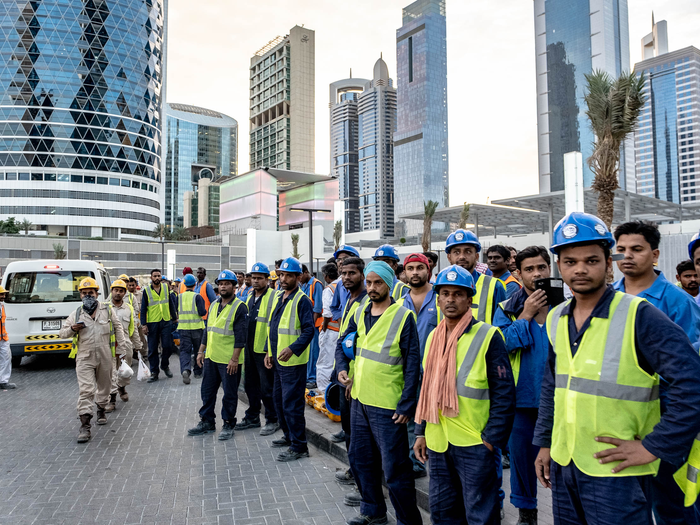
The problems these workers face are well known by the people of the UAE, with stories from them making it to the spotlight. Unfortunately, there are no private organizations to monitor the private businesses and government leaders remain silent. While unions for these workers are also non-existent, many workers still march against conditions they face, creating large public spectacles that catch people’s attention.
Policy:
The UAE and Dubai have put many policies in place to attempt to curb human rights abuses. Many of the activities recently mentioned, such as making workers pay money to be able to work in Dubai or withholding worker’s salaries, are expressly forbidden under the law. However, many construction companies continue to openly practice these wrongdoings, with little being done to stop them. Even with labor reforms enacted in 2017, over 10 years since many of these concerns were brought up, all of the problems mentioned persist. Either the government of Dubai and the UAE are too overwhelmed to do anything meaningful, or they simply don’t care.
Many issues faced by migrant workers in Dubai could be completely crushed by phasing out the sponsor system. They would no longer have to rely on someone in Dubai to allow them to work or have to pay a company to sponsor them. This would give them free reign and allow them to work on their own terms. Alternatively, Dubai needs to start cracking down on construction companies who simply do not care about following the law.
What you can do:
One of the most useful things you can do is donate to organizations focused on combatting rights abuses. One of the most notable is Human Rights Watch. You can click here [(https://donate.hrw.org/page/65440/donate/1?ea.tracking.id=EP2021EVpg)] to donate helping not just workers in Dubai, but people all over the globe.
Source:
“IV. Migrant Construction Workers in the United Arab Emirates.” Building Towers, Cheating Workers: Exploitation of Migrant Construction Workers in the United Arab Emirates: IV. Migrant Construction Workers in the United Arab Emirates, 2006, www.hrw.org/reports/2006/uae1106/4.htm.
Ullah, Areeb. “Migrant Workers Continue to Face Risks in Dubai, One Year Ahead of Expo 2020.” Middle East Eye, 21 Oct. 2019, www.middleeasteye.net/news/construction-firms-worker-rights-abuse-track-record-contracted-expo-2020.
“United Arab Emirates Labor Stats.” NationMaster.com, NationMaster, 2014, www.nationmaster.com/country-info/profiles/United-Arab-Emirates/Labor.


Comments