


Gendering Agriculture
Agriculture is the science or practice of farming, including cultivation of the soil for the growing of crops and the rearing of animals to provide food, wool, and other products. Agriculture provides humans with household necessities to uphold their homes efficiently. Applying a certain gender to uphold such a practice is referred to as gendering agriculture. Within the concept of applying a certain gender to a practice like agriculture, many women have stepped up to the plate to help contribute their efforts to society.
Gender plays a very important role within the practice of agriculture. As an understood variable, men are known to be working late nights, but that's not the case this time around. Specifically women tend to be perceived as an overlooked gender not having the capabilities to withstand working in the fields.
Africa
In sub-Saharan Africa women produce up to 80% of foodstuffs for household consumption and sale in local markets, according to a report by the World Bank and the Food and Agriculture Organization. The impact that women now have on the Agriculture industry is blowing the minds of many in Africa. Women's food production skills in the house and on the field help elevate the respect in the eyes of all residents for the female gender.
African leaders have also pledged to help women farmers under the 2003 Maputo Declaration. The Maputo Declaration is an effort to help develop a secure support system for smallholder farmers in Africa. To put into play this action, many women have helped to incorporate skills used within the household into the skills needed to work on the fields. They used food production as a skill set which eventually helped put forth a solution to end hunger. Grace Kamotho, a lecturer at Karatina University, where she also trains farmers in new farming technologies and practices, told Africa Renewal that “Being an African woman, I recognize the fact that women are more associated with food preparation and care of the family than men, and I understand the importance of feeding families with an appropriate and balanced diet.” Grace was one of the primary contributors who helped the cause of hunger all across the suburbs or Africa.
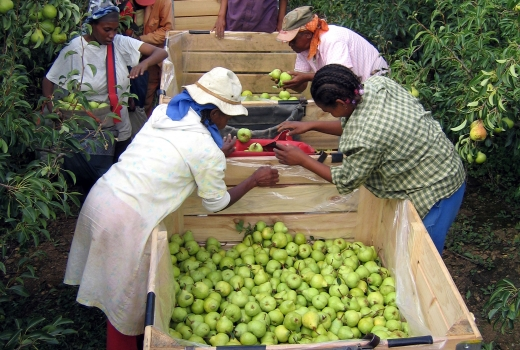
Source: The United Nations
Despite the role and impact of women in African agriculture, there’s still an unsettling disparity in the support they receive compared to men. Many argue that the reason behind low agriculture production is because due to the fact that most women don't have proper access to certain aspects like credits, land, and production inputs. Since all these tools are exceptionally important for agriculture, it has helped uplift many circumstances where now women can gain access to such fundamentals.
A bright future
Women have started to lead a bright trail for other women to follow . Female farmers are now benefiting from more training opportunities, incentives and other programmes designed to equip small-scale women farmers with information, skills and other inputs to improve crop quality and quantity.
Recently in Tanzania, the Bill and Melinda Gates Foundation has started providing women farmers with agronomy training that addresses gender-related norms and attitudes that discourage them from engaging in coffee production. The farmers learn how to improve coffee quality and quantity, which in turn increases their incomes. Overall, any production done in Africa depends heavily upon women's engagement within agriculture production due to their wide palette of skills.

Source: AUDA-NEPAD
How can you help
This concept of “gendering agriculture” ties back to gender equality and women's rights. What you can do to help is firstly stay educated, by doing so you will know the ups and downs behind the foundation underlying this specific topic. Secondly you can take a stand for women's rights, by signing petitions, educating friends and family, and take a look at other situations that also have their concept as a broad spectrum on gender restrictions or identification.
Another way to have a role in this situation is, to help women gain political power, which is where many women candidates can help empower the name of females in your country, so vote for them if you are eligible to vote. Lastly you can donate facilities to countries with low amounts of tools to help them succeed in their agricultural endeavors.
Resources
Araripe, E. (2019, January 21). 10 ways to promote gender equality in daily life. Retrieved November 01, 2020, from https://believe.earth/en/10-ways-to-promote-gender-equality-in-daily-life/
Behrman, J., Meinzen-Dick, R., & Quisumbing, A. (1970, January 01). Understanding Gender and Culture in Agriculture: The Role of Qualitative and Quantitative Approaches. Retrieved November 01, 2020, from https://link.springer.com/chapter/10.1007/978-94-017-8616-4_2
(n.d.). Retrieved November 01, 2020, from https://www.ifpri.org/publication/gender-agriculture
National Geographic Society. (2012, October 09). Agriculture. Retrieved November 01, 2020, from https://www.nationalgeographic.org/encyclopedia/agriculture/
Perry, P., & Richardson, P. (2019, April 05). Empowering female farmers to feed the world. Retrieved November 01, 2020, from https://www.nationalgeographic.com/culture/2019/03/partner-content-empowering-female-farmers/


Comments