


Period Poverty; A Continuously Shunned Crisis
And How to Help

A cardboard sign protesting the lack of accessibility of period products to those of the homeless community, as well as of poorer backgrounds.
© The Homeless Period on Facebook.
Yearly, millions of women in poverty suffer to provide food for themselves and their families; it is a struggle that has persisted for several decades. The issue is, poverty does not only limit itself to food, water access, or the ability to get a roof over your head- it is also a struggle that countless women face every day to attain period products. The problem at hand has been addressed and referred to as period poverty, or the “lack of accessibility to sanitary products, menstrual hygiene education, toilets, hand washing, facilities and/or waste management.” (Period Pride Campaign). It has only been spoken about recently, and changes are slowly being made as lawmakers find the problems at hand.
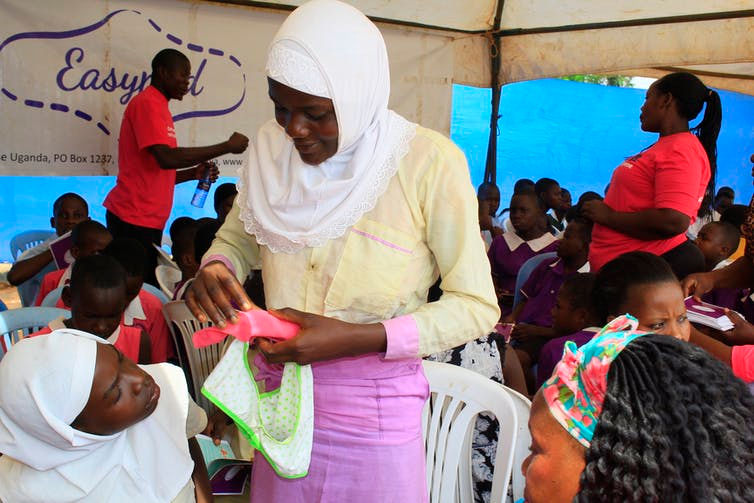
School girls attend an educational event to learn how to properly use reusable pads.
© Irise International, Author provided.
Women in Poverty
According to an American Progress report, an estimated 13.8% of women in the world live in poverty. The majority of these women do not have access to period products in their lives, and that needs to change. Period poverty is an excessive issue that has only recently been brought to light, yet still remains continuously shunned. Depending on what women have access to and can afford, the average woman will spend roughly $6360 on period products throughout their lifetime. That is exactly the kind of money that people in poverty do not have. Paying for pads and tampons is an exorbitant cost that, if eliminated, would save women thousands of dollars. When surveyed by the same source, 1/3 of women explained that they would put the money into becoming homeowners and being able to pay for a house. In another survey by the impressive organization Intima, an astonishing 69% of women stated that they believed the price paid for period products is too high.
Additionally, according to the same report, it's concluded that the estimated yearly income of a family of 4 in poverty has the poverty line-the max pay one could make to qualify as a person in poverty-set at $29,818. That means that the average woman would, at minimum, spend around a quarter of their yearly income for their family of 4 on period products. When put into perspective, women do not have access to this kind money; given that each of the 4 family members requires a quarter of the yearly income, the cost for feminine products would equal around the amount of money they would need for one year in poverty.

A woman utilizing Scotland's passing of a bill in which calls for no-cost feminine products.
© Rich Pedroncelli, The Associated Press files.
The Cost of Products
Not only do women in poverty not have access to period products, but they also are forced to “[make] do with cloth, rags, tissues, toilet paper and sometimes even diapers or paper towels taken from public bathrooms." says Business Insider. The same survey of low-income women in a large U.S. city found that “nearly two-thirds couldn’t afford menstrual hygiene products such as tampons or pads during the previous year.” Two-thirds of a large area's population not being able to afford products that they should have as a necessity spreads an important message- the cost of products like these are high to the point that it just cannot be paid for. In the same survey, “[n]early half the women said there were times in the past year when they could not afford to buy both food and period products.” When women need to decide between receiving food that they need to survive and getting feminine products, which they need for their personal hygiene, it is evident these problems women face are not going to end without drastic change.
To tack on to the cost of hygiene products already being so high, pads and tampons are taxed at ludicrous rates. Anne Sebert Kuhlmann, an associate professor in the College for Public Health and Social Justice at St. Louis University, addressed the issues that the lack of access to period products poses, stating that “in (some states) [period products] are taxed at the highest rate.” The tax placed on feminine products is absurd, and currently exists in 33 of the 50 states in the US; as high as 4% additional to sales tax in places like Georgia. Not only does this tax make it inaccessible for women in poverty who need the products, but it feeds into the stigma that period products are not necessities. Debates have transpired on why things like Viagra and condoms, which people use for personal benefit, not hygiene, are not taxed, yet tampons are, and many lawmakers in the US are beginning to address the problem and make changes to help make periods more affordable.
Ways to Get Involved
The following are links with many different sites and organizations that provide menstrual products for women who need them. Signing the petitions or donating any money that you can to organizations can help make a difference in the lives of people who do not have access to them, and to women and children who are going through tough times without them.
Join the Every 28 Days Club, (Donation).
References
Carroll, L. (2019, January 10). Even in the U.S., poor women often can’t afford tampons, pads. Retrieved September 5, 2020, from U.S. website: https://www.reuters.com/article/us-health-menstruation-usa/even-in-the-u-s-poor-women-often-cant-afford-tampons-pads-idUSKCN1P42TX#:~:text=Instead%2C%20the%20women%20said%20they,towels%20t aken%20from%20public%20bathrooms.
Center for American Progress. (2008, October 8). Retrieved September 5, 2020, from Center for American Progress website: https://www.americanprogress.org/issues/women/reports/2008/10/08/5103/the-straight-
Epstein, R. (2019, October 18). The Current State of the Tampon Tax—and How We’re Going to Eliminate It. Retrieved September 5, 2020, from Marie Claire website: https://www.marieclaire.com/politics/a29490059/tampon-tax-state-guide/
Hoffower, H., & McDowell, E. (2019, November). Here’s the income it takes for a family of 4 to be considered poor in every state - Business Insider. Retrieved September 5, 2020, from Business Insider website: https://www.businessinsider.com/income-amount-poverty-level-in-every-state-2018-11
Kane, J. (2015, May 18). Here’s How Much A Woman’s Period Will Cost Her Over A Lifetime. Retrieved September 5, 2020, from HuffPost website: https://www.huffpost.com/entry/period-cost-lifetime_n_7258780
Mercado, M. (2017, March 17). 10 Organizations That Provide Menstrual Products For People Who Need Them & How You Can Help. Retrieved September 7, 2020, from Bustle website: https://www.bustle.com/p/10-organizations-that-provide-menstrual-products-for-people-who-need-them-how-you-can-help-45116
New research reveals how much the average woman spends per month on menstrual products - digitalhub. (2019, November 27). Retrieved September 5, 2020, from digitalhub website:
https://www.swnsdigital.com/2019/11/new-research-reveals-how-much-the-average-
products/#:~:text=Results%20revealed%20the%20average%20woman,the%20money%2
https://www.swnsdigital.com/2019/11/new-research-reveals-how-much-the-average
products/#:~:text=Results%20revealed%20the%20average%20woman,the%20money%2
Period Pride Campaign - Keep our girls in school | Official Website. (2019). Retrieved September 5, 2020, from PeriodPrideCampaign website: http://periodpridecampaign.org/
Sign the Petition. (2018). Retrieved September 7, 2020, from Change.org website: https://www.change.org/p/people-around-the-world-make-feminine-products-free-and-more-accessible-in-school


Comments