


The Green New Deal; Just the Facts
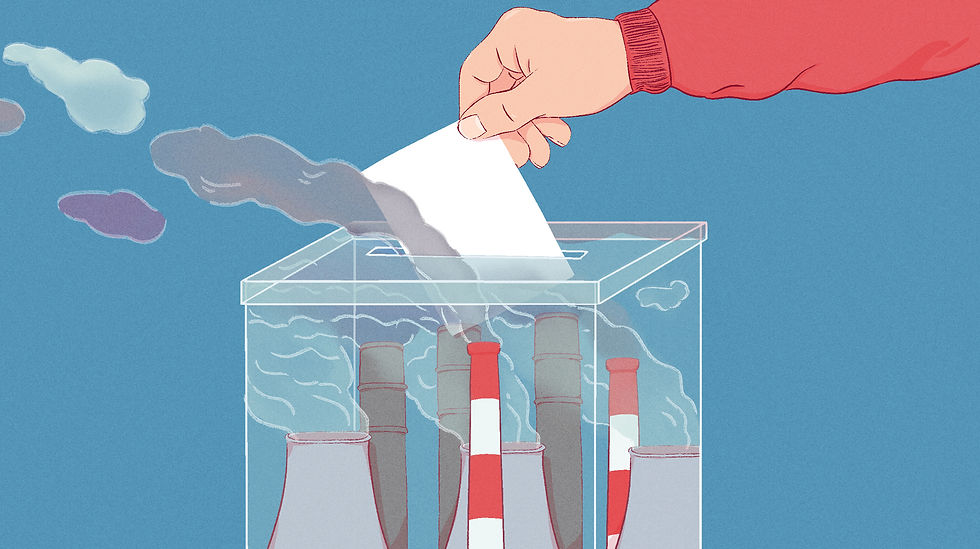
Democratic candidates have established many environmental plans so far, some of which cite the Green New Deal as an influence. © Adriana Bellet
The Green New Deal is a “10- year national mobilization” to develop sustainable practices to eliminate all carbon emissions for the United States. The bill was introduced in Congress by New York’s 14th District representative, Alexandria Ocasio-Cortez. As well as Senator Ed Markey from Massachusetts.
The goals of the Green New Deal are as follows:
A) to achieve net-zero greenhouse gas 6 emissions through a fair and just transition for all communities and workers;
B) to create millions of good, high-wage 9 jobs and ensure prosperity and economic security for all people of the United States;
C) to invest in the infrastructure and industry of the United States to sustainably meet the challenges of the 21st century;
D) to secure for all people of the United 15 States for generations to come—
i) clean air and water;
ii) climate and community resiliency;
iii) healthy food;
iv) access to nature; and
v) a sustainable environment; and
E) to promote justice and equity by stopping current, preventing future, and repairing historic oppression of indigenous peoples, communities of color, migrant communities, deindustrialized communities, depopulated rural communities, the poor, low-income workers, women, the elderly, the unhoused, people with disabilities, and youth (referred to in this resolution as ‘‘frontline and vulnerable communities’’);

With more than a hundred local chapters across the country, the Sunrise Movement, an organization encouraging the Green New Deal's passing, is making climate change an urgent priority. © Sunrise Movement
The Broadness of Climate Change
For the New York Times, Lisa Friedman wrote “What Is the Green New Deal? A Climate Proposal, Explained” She shares in her article that carbon emission rates are 3.4 percent higher than last year in the United States. As well as, 2.7 percent globally. Friedman describes that the goal of the Green New Deal is, “to reduce greenhouse gas emissions in order to avoid the worst consequences of climate change while also trying to fix societal problems like economic inequality and racial injustice.” This attention to the racial and economic effects of climate change is apparent in Ocasio-Cortez’s Green New Deal.
In essence, black and brown communities are more affected by climate crises by being kept in communities with poor air quality and chemical dumps nearby. This practice is called redlining, a practice of keeping communities separate and pushing low income, black, and brown communities to dying land. Even though the Green New Deal does not directly address redlining Section E demands the “justice and equity by stopping current, preventing future, and repairing historic oppression of indigenous peoples, communities of color, migrant communities,” This is vital to the integrity of climate change because it acknowledges the adverse effect of climate change on communities of color.
The cost of the Green New Deal is examined by Friedman later on in her article. She uses Vermont as a microcosmic example saying, “In Vermont alone, which has a goal of achieving 90 percent renewable energy by midcentury, the cost is estimated at $33 billion. Yet the state is seeing job growth in clean energy sectors and expects the transition will spur cost savings for consumers.” So it will cost money but the benefits easily outweigh the cost. Not only is Vermont experiencing job growth but they are making efforts to save our planet before we reach a point of no return.
Updating the country's power grid is another hefty provision included in the Green New Deal. In “Here’s what the Green New Deal actually says” by Zachary B. Wolf he provides a more in-depth analysis of what is required to create a ‘smart’ power grid. He says that “The Department of Energy has provided some funds since then, according to the Congressional Research Service, putting $3.6 billion each year toward the smart grid -- not nearly enough to implement it nationwide by 2030. It'll cost hundreds of billions of dollars over 20 years, according to estimates, but greatly improve the country's electrical infrastructure.” Meanwhile, in Friedman’s NYT article, she claims“Modernizing the electrical grid across the United States could cost as much as $476 billion, yet reap $2 trillion in benefits, according to a 2011 study issued by the Electric Power Research Institute.”

A sit in protest at Republican Nancy Pelosi's office, whom denounced the bill, , organized by the Sunrise Movement. © Sunrise Movement
Struggle for Implementation
Though having not passed many times in the senate the Green New Deal still has life. Democratic Candidate Joe Biden states on his website that, “Biden believes the Green New Deal is a crucial framework for meeting the climate challenges we face. It powerfully captures two basic truths, which are at the core of his plan: (1) the United States urgently needs to embrace greater ambition on an epic scale to meet the scope of this challenge, and (2) our environment and our economy are completely and totally connected.” Joe Biden’s focus on environmental justice and climate change are a stark contrast to current President Donal Trump’s complete denouncement of climate change as a “hoax.”
Julian Brave NoiseCat writes for The Guardian “Joe Biden has endorsed the Green New Deal in all but name” She describes how, “like the Green New Deal, Biden’s plans reframe climate action as a job, infrastructure, and clean energy stimulus...In his view, climate action cannot be separated from economic, environmental, and social justice.” Hopefully, the structure set out by the Green New Deal will inform Joe Biden’s presidential policies. We are reminded of the impending environmental crisis every day. From the fires in California to the hurricanes in the south. It is only a matter of time before this is entirely irreversible. Climate Change is often seen as a long term problem, but today it is painfully immediate.
It may not have been passed in congress, but the principles of the Green New Deal have paved a new way in Climate Change policies and have provided a path to a carbon emissions-free world. Despite, Donald Trump leaving the Paris Climate Agreement in June 2017. Joe Biden vows to rejoin the Paris Climate Agreement if he is elected in 2020. The climate crisis is looming now and must be addressed before there is no turning back.
How to Help
Educate yourself, by visiting the Sunrise Movement's website, to learn to how to get involved on the inside.
Take advantage of us researching the most reliable petitions for you, and take the final step of adding a signature.
With the help of the Sierra Club, encourage your local senators to endorse the Green New Deal, or once again visit the Sunrise Movement's website.
If able, donate to 350.org to encourage climate action to be taken seriously.
Sources cited in text.


Comments