


The Nationality and Borders Bill 2021
Background to the Bill
The Nationality and Borders Bill is currently making its way through the UK Parliament. It is a government Bill being sponsored by Priti Patel in her capacity as Home Secretary. The opening lines of the Bill state that its purpose it to ‘Make provision about nationality, asylum and immigration; to provision about victims of slavery of human trafficking…’ The most recent stage which the Bill completed was the Second Reading in the House of Commons which was held on Tuesday 20th July and allowed MPs to debate the contents of the Bill.
Contents of the Bill
The Bill seeks to differentiate refugees arriving to the UK into two categories; genuine refugees and non-genuine. Genuine refugees are defined in the Bill as someone who has come from ‘a country or territory where their life or freedom was threatened … and they have presented themselves to the authorities’. Contrary to these ‘genuine refugees’ are people referred to as ‘economic migrants’ by Priti Patel. By separating refugees into these two categories, the government aims to help those most in need, prioritising those who are fleeing dangerous territories.
Part 4 of the Bill addresses the issue of modern slavery. This section makes several amendments to the Modern Slavery Act 2015. The Bill also introduces a recovery period for those who are suspected victims of modern slavery. This is a period of 30 days in which the person in question has the right to remain in the UK whilst the relevant authorities investigate their case. The Bill also states that those placed in the recovery period should be provided with adequate support for their physical and mental health, along with their social wellbeing for the duration of the recovery period.
It should be noted that this recovery period can be waived if the person in question is proven to be a foreign criminal or involved in a previous terrorism offence.
The Bill addresses other issues, such as the inheritance of British citizenship from a mother or father; priority removal notices for immigrants and immigration enforcement. A link to the Bill is included in the ‘Sources’ section for further reading.
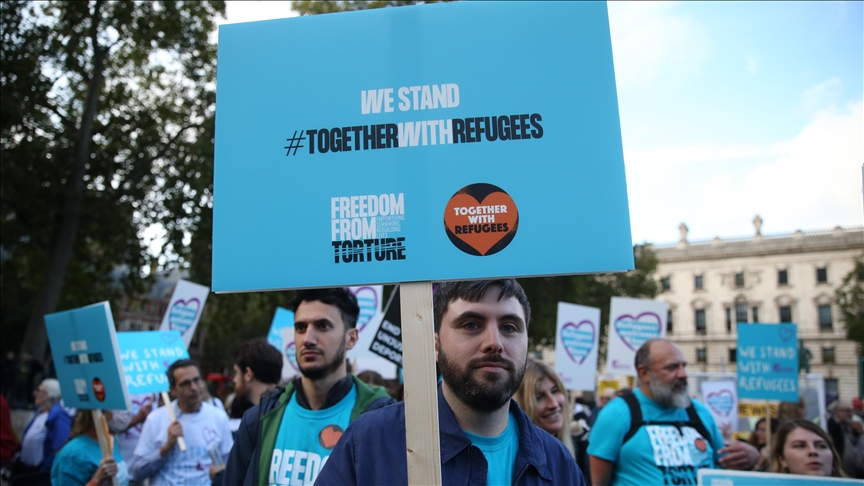
Source: Anadolu Agency
Support for the Bill
Conservative MP Tim Loughton spoke in favour of the Bill during the debate. He highlighted the concerns of those living in coastal communities in the south of England. Due to the geographical proximity between this area and France, many immigrants coming across the English Channel come ashore here. Loughton described people coming to the UK this way as ‘queue jumpers,’ taking spaces from others who had applied for entry to the UK. This example supports the government’s attempt to differentiate refugees into two groups; the ‘good’ refugee who applies for entry, and the ‘others’ who come across in boats.
Conservative MP Joy Morrissey supported the Bill in her speech. Having come to the UK as an immigrant, she supported Priti Patel’s ‘work to create a level of expediency and transparency for those who have rightly come here to work.’
Criticisms of the Bill
Despite strong government support, the Bill was repeatedly challenged by MPs during the Second Reading. Scottish MP Amun Qaisar-Javed criticised the ‘two-tier system which the Tories are creating’ in their categorisation of immigrants. She went on to praise the contributions which immigrants make to British society, often working for the National Health Service.
Labour MP Kerry McCarthy also raised the benefits of immigration to British society. She commended the performance of England’s team in the Euro 2020 football championships in helping to bring different communities together in the UK.
In addition to these social aspects of immigration, she argued that immigration brings economic benefit to the UK. She described the ‘acute labour crises in key economic sectors’ such as hospitality, agriculture and transportation. The shortage of workers in the UK has led to many problems in these areas, one such example is the shortage of lorry drivers, which is causing problems with food supplies in supermarkets and other shops. A lack of agricultural workers means that much produce grown in the UK is wasted while many go hungry at the same time. These problems could be solved with an increase in workers, which immigration can provide for these essential jobs.
Ways to get involved
Follow the work of Parliament in scrutinising and amending the Bill, which is in the committee stage at the time of writing
Sources
Nationality and Borders Bill (2021) Available at: https://publications.parliament.uk/pa/bills/cbill/58-02/0141/210141.pdf
Home Office (2021) ‘Home Secretary opening speech for Nationality and Borders Bill’ Available at: https://www.gov.uk/government/speeches/home-secretary-opening-speech-for-nationality-borders-bill
Hansard (2021) ‘Nationality and Borders Bill: Volume 699: debated on Tuesday 20 July 2021’ Available at: https://hansard.parliament.uk/commons/2021-07-20/debates/D6FA6055-BA80-4980-AE15-910876BB1E19/NationalityAndBordersBill


Comments